
Crop Rotation Made Simple
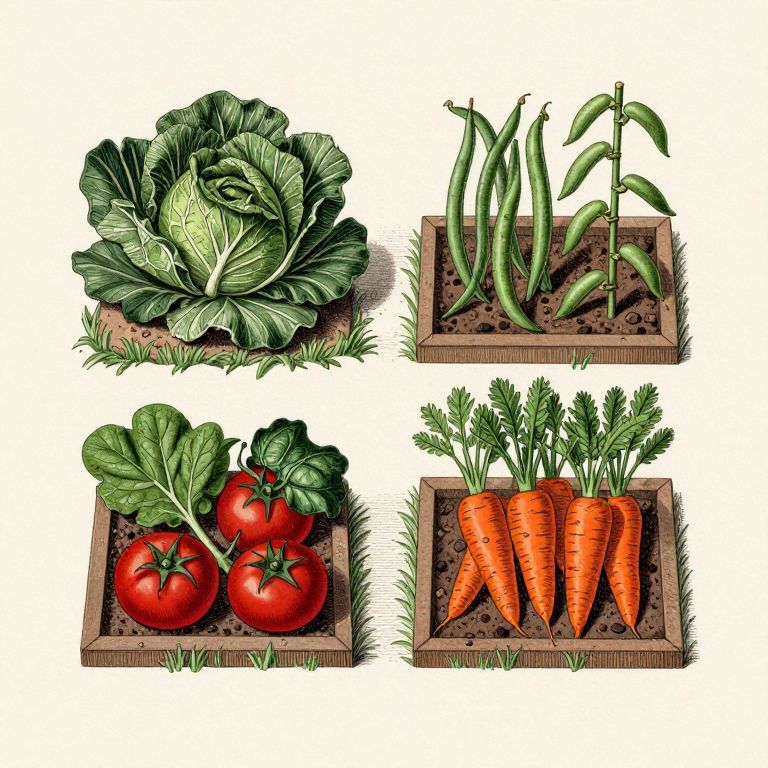
The whole rule is: don't grow a plant family where the same family grew last year. Everything else — four-year plans, colour-coded charts — is refinement on that one idea. Rotation matters because soil-borne diseases specialise by family and accumulate where their host keeps returning. Clubroot in brassicas can survive more than 15 years in infected soil, which makes prevention the only realistic strategy.
It is also, quietly, the practice that earns its reputation. Much of companion planting is untested tradition; rotation is standard agronomic practice with a century of evidence behind it. If you only adopt one organising principle for your beds, adopt this one.
The groups that need to move
Rotation works on botanical families, not on individual crops. These are the groups on file here — each crop links to its full record.
Nightshades
4 cropsHeavy feeders. Share early blight, late blight and verticillium wilt — the single most important group to keep moving.
Brassicas
12 cropsHeavy feeders and the group most vulnerable to a persistent soil disease (clubroot), which can survive 15+ years once established.
Legumes
3 cropsFix their own nitrogen. Traditionally follow the heavy feeders, though the benefit arrives when the residue breaks down, not during the season itself.
Alliums
4 cropsLight feeders with few shared pests. Useful as a gap year between demanding groups.
Cucurbits
6 cropsHeavy feeders, sprawling, and share bacterial wilt and squash bugs.
Roots
3 cropsLight feeders that break up soil. Avoid fresh manure, which makes them fork.
Leafy greens
3 cropsFast, shallow-rooted, nitrogen hungry. Easy to slot in anywhere.
Other
21 cropsPerennials and odd ones out — mostly stay where they are.
A four-bed rotation that works
With four beds you can run the classic sequence. Each group moves one bed along every year, so nothing returns to the same soil for four years.
| Year | Bed 1 | Bed 2 | Bed 3 | Bed 4 |
|---|---|---|---|---|
| Year 1 | Legumes | Leafy & brassicas | Fruiting | Roots |
| Year 2 | Leafy & brassicas | Fruiting | Roots | Legumes |
| Year 3 | Fruiting | Roots | Legumes | Leafy & brassicas |
| Year 4 | Roots | Legumes | Leafy & brassicas | Fruiting |
On legumes and nitrogen. The traditional reason for putting legumes first is that they fix nitrogen for the crop that follows. That is true but slower than most charts imply: isotope-tracer studies show the fixed nitrogen stays overwhelmingly in the legume's own tissue during the season, and the benefit to following crops arrives once the residue breaks down. So dig the plants in rather than pulling them out — and don't expect a neighbouring plant to be fed by a bean growing next to it this summer.
Rotating in a small garden
- Two beds: alternate demanding groups (nightshades, brassicas, cucurbits) with lighter ones (roots, alliums, legumes). A two-year gap is not ideal but breaks most pest cycles.
- One bed: split it into quarters and move families around within it. Keep a written record — after two seasons nobody remembers what was where.
- Containers: the easiest case. Change the mix, or at minimum don't refill a pot with the same family it grew last year.
- Perennials — asparagus, rhubarb, herbs — stay put. Rotation doesn't apply to them; site them well the first time, out of the way of the beds you'll be turning over.
Rotation beats adjacency
It is worth being blunt about the priority here. Gardeners spend a lot of energy on which plant sits next to which, and comparatively little on what grew in that soil last year — when the evidence points firmly the other way. Most companion pairings have never been tested; rotation is foundational agronomy. Get the rotation right first, then treat companion planting as a bonus.